Curse
The Best Werewolf Short Stories 1800-1849Curse is the supernatural mechanism that converts Krantz’s marriage promise to Christina into a hereditary sentence. Sworn in the wilderness before Wilfred of Barnsdorf, it binds Krantz not only to protect, cherish, and love Christina, but also to suffer the vengeance of the spirits if he breaks his word. The oath turns a private marriage arrangement into a cosmic contract, and its consequences extend beyond the husband and wife to their children, making the curse the central link between Krantz’s violence, his family’s destruction, and the fear of punishment still awaiting the narrator.
Origin in the Marriage Oath
The curse begins when Wilfred of Barnsdorf offers Krantz his daughter Christina in a remote country where there is no priest and, as Wilfred emphasizes, no ordinary law to compel a marriage ceremony. Wilfred therefore proposes a substitute ritual: Krantz must take Christina by the hand and repeat the required words. The setting makes the vow a threshold act, neither fully Christian nor merely secular. It is presented as a marriage, but its authority comes from the spirits of the Hartz Mountains rather than from a church, a court, or a recognized human community.
Krantz first hesitates when Wilfred chooses the spirits instead of Heaven as the witnesses to the oath. Wilfred answers that the choice is his own, and he presses Krantz to accept the ceremony or surrender Christina. Krantz agrees, and the vow specifies three positive duties: he will take Christina as his wedded wife, protect her, cherish her, and love her; above all, he will never raise his hand against her to harm her. The curse is therefore not an arbitrary punishment imposed on an innocent man. It is attached to a clearly stated condition, and the later haunting repeatedly returns to the exact obligation Krantz accepted.
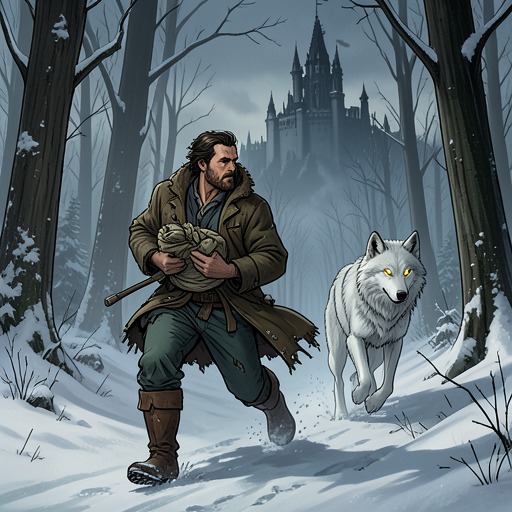
The sanction is pronounced immediately after the promise. If Krantz fails, the spirits’ vengeance will fall upon him and his children; they may perish by the vulture, the wolf, or other beasts of the forest, their flesh torn from their limbs and their bones left to blanch in the wilderness. Marcella’s tears when the final words are repeated show that the threat already possesses emotional weight within the household. The oath is not treated as a metaphor or as a merely ceremonial flourish. It is spoken aloud, recorded in supernatural terms, and made transmissible through the family line.
Breach and Supernatural Enforcement
The curse becomes active when Krantz violates the promise that his hand will never be raised against Christina and is also guilty of a double murder. Wilfred later returns as a supernatural hunter to confront him, and Krantz attempts to reject the entire transaction by claiming that he made no compact with evil spirits. That denial cannot undo the ritual. Wilfred insists that Krantz did make the compact and that the vow itself is the evidence against him.
The confrontation exposes the curse’s peculiar logic. Wilfred does not simply threaten revenge; he recites the terms Krantz accepted, naming the vulture and the wolf and recalling the fate of bones bleaching in the wilderness. When Krantz attacks him with an axe, the weapon passes through the hunter’s form. The failed blow demonstrates that ordinary violence cannot resolve a judgment grounded in the supernatural order. Krantz’s physical force is powerless because the curse has already placed his conduct within a larger system of retribution.
Wilfred then identifies the double murder as the decisive offense. He declares that the spirits have power over those who have committed murder and that Krantz must pay the penalty attached to his marriage vow. Two of Krantz’s children are already gone, and the third is destined to follow because the oath is registered. The curse thus joins crime and kinship: Krantz’s own guilt activates the penalty, but the suffering is distributed across his descendants. The resulting justice is terrifying precisely because it is both personal and indiscriminate.
Punishment, Survival, and Recurrence
The curse does not grant Krantz the release of death. Wilfred tells him that it would be kindness to kill him, but that his punishment is to live. This reversal gives the curse its most severe form. Death would end responsibility and silence the offender; continued life forces Krantz to endure the consequences of his oath, his murders, and the disappearance of his children. The punishment therefore works through duration, memory, and helpless witnessing rather than through a single spectacular execution.
After Wilfred disappears, Krantz rises, embraces the surviving child tenderly, and kneels in prayer. The gesture does not cancel the curse, but it marks a brief human response after the supernatural verdict. The following morning he leaves the cottage forever, taking the child with him toward Holland. His escape from the original dwelling is not an escape from the oath. In Amsterdam, he is seized by a brain fever and dies raving mad, while the child is placed in an asylum and later sent to sea before the mast. The family’s dispersal becomes another consequence of the curse: home, sanity, and ordinary inheritance are all broken apart.
The final question is whether the penalty passes to the surviving child. The narrator remains convinced that, in some manner, the father’s oath must be paid. That uncertainty keeps the curse alive beyond Krantz’s death. The supernatural sentence has already fulfilled several of its declared forms, yet its full reach remains unresolved, turning the family history into an anticipatory threat rather than a closed legend.
Ritual, Atmosphere, and Narrative Meaning
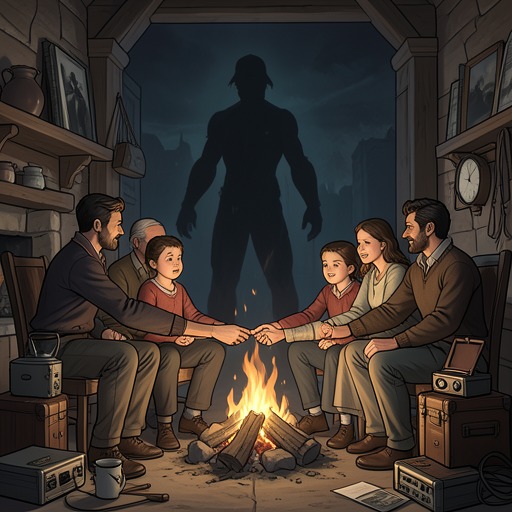
The curse is embedded in a sequence of ceremonies and charged communal settings. It is born through a substitute marriage ritual, remembered against a background of wilderness and the Hartz spirits, and later recalled through an encounter in which the supernatural judge quotes the oath back to its violator. Elsewhere, the narrative repeatedly places fear beside formal public rites: All Souls’ Eve is described as the haunted night before All Souls’ Day, when the dead are reputed to rise and return home; the orphaned survivors keep vigil beside a recently emptied hearth while the forest wind and darkness make the unseen threat seem present; and the public proceedings at Loques surround alleged magic with religious ceremony, judgment, and execution. These contrasts show two rival systems of order. Human society tries to contain fear through law, mass, proclamation, and punishment, while the curse operates through a private vow whose authority exceeds those institutions.
The curse also depends on the story’s unstable border between Christian language and older supernatural power. Krantz questions why the oath should not be sworn by Heaven, but Wilfred insists on the spirits of the Hartz Mountains. The resulting formula resembles a marriage vow in its promises of protection and love, yet its penalty invokes beasts, torn flesh, and wilderness rather than ecclesiastical judgment. This hybrid ritual makes the curse difficult to dismiss as either ordinary superstition or orthodox religion. It belongs to a darker jurisdiction, one that recognizes spoken promises as binding even when human law does not.
As a narrative device, the curse converts past actions into present dread. The oath is first spoken as a condition of marriage, then repeated as evidence during the confrontation, and finally carried forward as an unresolved burden in the narrator’s life. Each recurrence narrows the space for disbelief. The curse’s decisive significance lies in that progression: a moment of consent becomes a family history, a rejected warning becomes a supernatural verdict, and the attempt to flee becomes only another stage in the punishment.